BIRTH OF LORD BYRON
January 22, 1788
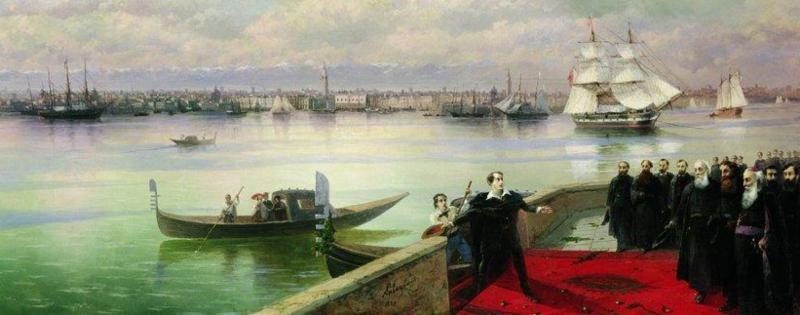
Byron’s visit to San Lazzaro by Ivan Aivazovsky
For two centuries, Lord Byron’s Armenian connection has become the stuff of legend, and the fact that one of the greatest British poets took an interest in the Armenian culture to the point of learning the language has been widely discussed.
George Gordon Byron was born on January 22, 1788 in London. He spent his childhood in Aberdeenshire. His father, a womanizer mired in debts, died when he was three years old, and he remained under the care of his mother. After his elementary education in Aberdeen Grammar School and a private school in Dulwich, from 1801-1805 he studied in Harrow School, a boarding school in London. In 1805 he went up to Trinity College, in Cambridge, where he spent three years, engaging in sexual escapades, boxing, horse riding, and gambling.
Byron had written poetry since his teenage years, and after he recalled and burned a book called Fugitive Pieces, he published his actual first book, Hours of Idleness, in 1807. It was savagely reviewed in Edinburgh, and Byron responded in 1809 with his first major satire, English Bards and Scotch Reviewers.
As it was customary for young noblemen, Byron undertook a grand tour of Europe from 1809-1811. He avoided most of continental Europe due to the Napoleonic wars, and instead he traveled through the Mediterranean. He went over Portugal, Spain, Albania, and Greece, and he reached the Ottoman Empire, visiting Smyrna and Constantinople. He returned to England from Malta in July 1811.
The next year, Byron became a celebrity with the publication of the first two cantos of his poem Childe Harold’s Pilgrimage, which established him as a leading romantic poet. His last period in England included the production of many works. However, his rising star was darkened by scandal. Various love affairs, including rumors of an incestuous relationship with his half-sister Augusta Leigh, and the pressure of debt led him to seek marriage with Annabella Millbanke in 1815. They had a daughter in the same year, but the marriage did not end Byron’s escapades, but ended in disaster. His wife left him in January 1816 and divorced him. Rumors and debts did not end, and Byron left England three months later for good.
After a few months in Switzerland, Byron wintered in Venice, where he resumed his love adventures with two married women. It was natural, then, that he visited for the first time the monastery of San Lazzaro in November 1816. However, he was not just a random visitor of the Mekharist Congregation. He made his goal to get acquainted with Armenian culture and, more importantly, to study the Armenian language with Rev. Harutiun Avkerian (Pascal Aucher). In a letter of December 1816 to his publisher Thomas Moore, he wrote: “By way of divertissement, I am studying daily, at an Armenian monastery, the Armenian language. I found that my mind wanted something craggy to break upon; and this — as the most difficult thing I could discover here for an amusement — I have chosen, to torture me into attention. It is a rich language, however, and would amply repay any one the trouble of learning it. I try, and shall go on; — but I answer for nothing, least of all for my intentions or my success.”
He collaborated with his teacher in two books: Grammar English and Armenian (1817), an English textbook for Armenians, and A Grammar Armenian and English (1819), a grammar of Classical Armenian for the use of English speakers. Byron also translated from Armenian the Epistle of Paul to the Corinthians, two chapters of Movses Khorenatsi’s History of Armenia, and section of Nerses Lambronatsi’s Orations. The poet’s lyricism would become an inspiration for many Armenian poets of the nineteenth and early twentieth century.
In Venice, Byron also wrote the fourth canto of Childe Harold, and around the same time, he published other poems. He wrote the first five cantos of Don Juan between 1818 and 1820, and continued his work in Ravenna from 1819-1821. He fell in love with eighteen-year-old Countess Teresa Guiccioli, a married aristocrat who abandoned her husband and followed him to Ravenna, Pisa, and Genoa. Living in this city, in July 1823 accepted an offer from representatives of the Greek independence movement and left Genoa for Greece. He first settled in the Ionian Islands and then traveled to the mainland in January 1824.
Byron settled in Missolonghi, in southern Greece, and was entangled in the internal fights of different Greek factions. However, his presence in Greece would draw the increasing active participation of European nations. He sold his estate in Scotland to help raise money for the revolution. When planning an attack on Lepanto, at the mouth of the Gulf of Corinth, Byron fell ill in February 1824. He made a partial recovery, but caught a strong cold in April, and then developed a violent fever, which caused his death in Missolonghi on April 19, 1824. His remains were sent to England for burial in Westminster Abbey, but this was rejected for reason of “questionable morality.” He is buried at the Church of St. Mary Magdalene in Hucknall, Nottinghamshire.
A statue remembers Byron in Athens, and April 19, the anniversary of his death, is honored in Greece as “Byron Day.” A street also bears his name in Yerevan.


